Best Forex Brokers in India: Regulatory Pass-Fail Test
The central pricing inefficiency in searches for the best forex brokers in India is not a spread differential. It is the assumption that a global broker offering EUR/USD at 0.1 pips is comparable with a domestic, exchange-connected provider.
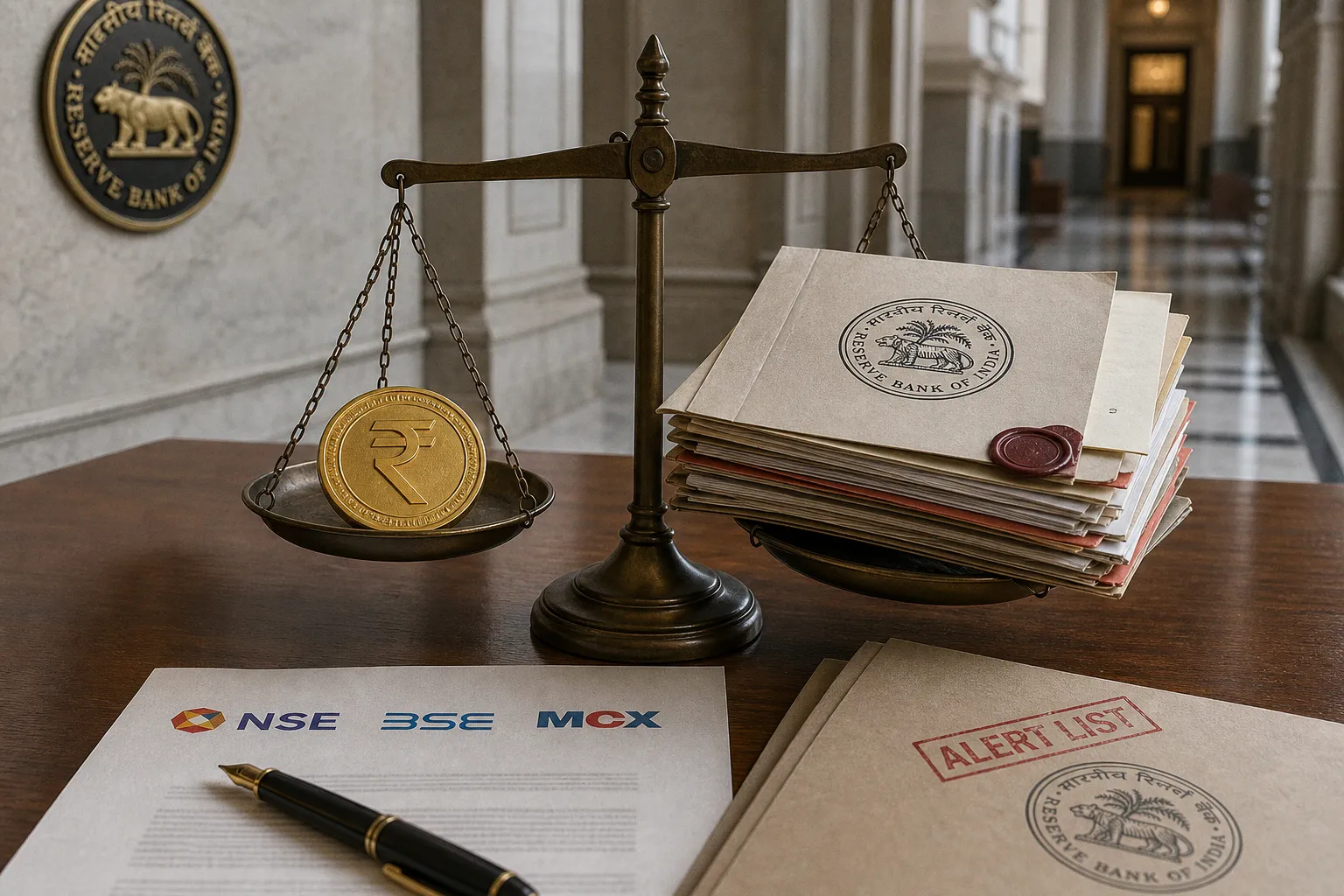
India does not operate an open retail spot-FX market. The legal route is exchange-traded currency derivatives through a SEBI-registered broker and a recognised domestic exchange. The investable universe is restricted to seven pairs. The offshore universe, despite its familiar platforms and aggressive marketing, carries a different risk distribution: regulatory exposure is not a remote tail risk when the Reserve Bank of India has explicitly listed the platform.
That distinction matters more than any advertised commission. A low trading cost on an unauthorised venue has a poor risk-adjusted value if the account structure itself fails the regulatory test.
In India, the first broker filter is not “lowest spread.” It is whether the trade can exist within the permitted market structure.
The legal framework: why exchange-traded derivatives are the baseline
Under the Foreign Exchange Management Act framework, Indian residents may access foreign-exchange markets through exchange-traded currency derivatives on recognised domestic venues:
- National Stock Exchange of India (NSE)
- BSE
- Metropolitan Stock Exchange of India (MSE)
The broker must be registered with SEBI and provide access to the relevant currency-derivatives segment. This is the baseline scenario. A firm may have a polished mobile terminal, MetaTrader integration abroad, copy-trading tools, or apparently deep liquidity. None of those features compensates for failing the jurisdiction and venue test.
The phrase “RBI-approved forex broker” is also imprecise. The RBI regulates the foreign-exchange framework and publishes its Alert List of unauthorised entities. Broker registration and exchange access sit within the SEBI and domestic-exchange structure. A better operating test is therefore straightforward: can the broker demonstrate SEBI registration and provide exchange-traded access to the permitted currency contracts?
The distinction between a regulated domestic route and an offshore retail platform is material.
| Parameter | SEBI-registered, exchange-connected route | Offshore spot/CFD platform |
|---|---|---|
| Trading venue | Recognised Indian exchange | Platform-operated or overseas venue |
| Product structure | Exchange-traded currency derivatives | Usually spot FX, CFDs, or rolling contracts |
| Permitted universe | Seven specified pairs | Often dozens of pairs and synthetic products |
| Regulatory fit for Indian residents | Baseline compliant route, subject to exposure rules | Not a legal substitute for domestic ETCD access |
| Settlement and oversight | Domestic market infrastructure | Depends on offshore entity and jurisdiction |
| Main risk variable | Contract suitability and exposure documentation | Regulatory, transfer, and platform-access risk |
The practical implication is blunt. A search result describing a firm as one of the “top forex brokers in India” has no analytical value until its product and regulatory route are separated. Many rankings compare global CFD brokers by leverage, spread, deposit size, and bonuses. Those metrics are designed for a market Indian residents are not permitted to use as a substitute for domestic currency derivatives.
The regulatory pass-fail test for a forex broker
A broker review in India should start with disqualification conditions, not a weighted scoring model. A platform either clears the legal structure or it does not. Only after that point does it make sense to compare brokerage, margin interface, order handling, and market-data quality.
The decision tree has four stages.
1. Identify the executing entity, not just the brand.
A brand may operate through multiple legal entities across jurisdictions. The relevant question is which entity opens the account for an Indian resident and where the trade is executed. A global brand name does not establish domestic authorisation.
2. Confirm SEBI registration and exchange membership access.
The broker must be able to offer currency derivatives on NSE, BSE, or MSE. A platform that only offers international spot FX, CFDs, or contracts settled outside the domestic exchange framework fails this stage.
3. Check the contract against the permitted pair list.
Access to a legal broker does not convert every currency pair into a legal product. The permitted set is limited. A platform advertising AUD/USD, USD/CAD, USD/CHF, XAU/USD, or crypto-linked currency products is advertising instruments outside the authorised retail currency-derivatives universe.
4. Assess whether the trader has a valid underlying exposure.
Since May 3, 2024, the operative risk is not merely choosing a compliant broker. Currency derivative positions require an underlying contracted foreign-currency exposure. A speculative directional view on USD/INR is not, by itself, the same thing as documented hedging activity.
This process may look restrictive relative to a standard global brokerage comparison. It is restrictive. That is the market design. The correct comparison is therefore between domestic execution routes for a qualifying hedging requirement, not between a domestic broker and an offshore high-leverage CFD account.
What a compliant platform should actually provide
For a user with a qualifying foreign-currency exposure, the best forex trading platform in India is not necessarily the one with the most indicators. It is the one that allows the hedge to be matched, monitored, and closed with minimal operational slippage.
The relevant features are practical:
- Clear access to the currency-derivatives segment of a recognised exchange.
- Contract specifications visible before order placement.
- Transparent initial and maintenance margin requirements.
- Reliable order types for entering and reducing hedge positions.
- Position reports that can be reconciled with the underlying commercial exposure.
- A clear process for declarations and documentation.
- Defined procedures for expiry, rollover, and physical or cash-settlement implications where applicable.
- Stable access during domestic currency-market hours, rather than a platform built around 24-hour offshore CFD turnover.
A sophisticated charting package is useful. It is not the primary control. A risk manager does not choose an execution venue because the chart has more oscillators. The relevant question is whether the position can be defended if the broker, exchange, bank, or regulator asks what economic exposure the contract is offsetting.
Decoding the RBI Alert List: 95 platforms are not a minor warning
As of the RBI’s November 19, 2025 update, the Alert List contained 95 unauthorised entities. This is not a list of merely uncompetitive brokers. It identifies platforms that are not authorised to deal in foreign exchange for Indian residents under the applicable framework.
The list includes widely recognised international names, among them eToro, Exness, OctaFX, XM, FXCM, and Fusion Markets. Their inclusion changes the probability-weighted analysis materially. A platform’s global licence, years in business, or popularity in other countries does not transfer into a valid route for an Indian resident.
The usual sales narrative relies on false equivalence: a broker is regulated somewhere, therefore it is safe everywhere. That is not how jurisdictional risk works. Regulation is entity-specific, product-specific, and client-location-specific.
There are several reasons the offshore route has an asymmetric downside:
- Funding risk. Cross-border deposits and withdrawals can attract scrutiny where the underlying trading activity is unauthorised.
- Access risk. Platform websites, payment channels, or account services can be disrupted without the protections expected from domestic market infrastructure.
- Dispute risk. A client may be dealing with an overseas entity outside the practical reach of Indian complaint and remediation mechanisms.
- Product risk. High leverage can magnify a modest exchange-rate move into a disproportionate loss.
- Compliance risk. The trade itself may not be permitted, irrespective of whether the position is profitable.
The last point is decisive. A trader may be correct on direction and still have selected an unusable venue. That is a poor risk-reward ratio: limited incremental convenience in exchange for open-ended legal and operational uncertainty.
An offshore broker can quote tighter spreads while carrying a risk premium that no spread comparison captures.
The RBI Alert List should be treated as a hard exclusion filter. It is not a watchlist for bargain hunters. If a platform appears there, the invalidation level is immediate: do not treat it as a candidate for Indian-resident forex trading.
The underlying exposure mandate changed the tradeable market
The largest structural change for retail participants took effect on May 3, 2024. The RBI required currency-derivative traders to have a compulsory underlying contracted exposure to foreign currency. In effect, this removed the straightforward speculative-retail model that many traders associate with forex platforms.
The distinction is between hedging and directional speculation.
A business expecting a USD receivable, an importer facing a USD payable, or a person with a contracted foreign-currency obligation may have an underlying exposure that can be managed through permitted derivatives. A trader opening USD/INR futures solely because a chart suggests rupee depreciation does not have the same foundation.
The $100 million threshold matters in documentation, but it should not be misunderstood as a licence to speculate. For exposures below that level, a declaration can suffice; above it, documentary proof is required. The mechanism changes the evidence standard. It does not erase the requirement for an underlying exposure.
This creates a different broker-selection matrix.
| Use case | Regulatory fit | Platform priority | Core risk |
|---|---|---|---|
| Importer hedging a contracted USD payable | Potentially aligned with the framework | Execution reliability, expiry management, documentation | Hedge mismatch and basis risk |
| Exporter hedging a contracted foreign-currency receivable | Potentially aligned with the framework | Position reporting, rollover process, margin planning | Over-hedging or delayed receivables |
| Investor seeking leveraged EUR/USD speculation | Fails the underlying-exposure premise | No valid domestic retail platform substitute | Regulatory and leverage risk |
| Trader copying signals from an offshore account | Fails venue and product tests | None | Unauthorised platform exposure |
| Company managing multiple currency flows | Potentially aligned, subject to structure | Controls, reporting, position aggregation | Documentation and concentration risk |
This framework is not designed to optimise trade frequency. It is designed to contain currency risk associated with real economic activity. That is why attempts to identify a “best broker” by scalping conditions, bonus offers, or maximum leverage miss the relevant variable.
For a qualifying user, the better question is: can this broker help maintain hedge discipline through changing margin, expiry, and documentation conditions?
The seven permitted pairs and the hours that shape liquidity
The permitted set contains four INR-based pairs:
- USD/INR
- EUR/INR
- GBP/INR
- JPY/INR
It also includes three cross-currency pairs:
- EUR/USD
- GBP/USD
- USD/JPY
That is the complete retail universe under the stated framework. The narrower range has direct implications for hedging strategy. An exposure in a currency outside these pairs may require a different risk-management approach rather than a search for an offshore workaround.
For INR-based pairs, standard domestic trading hours run from 9:00 AM to 5:00 PM IST. The cross-currency contracts trade later, up to 7:30 PM IST. These hours matter because exchange-rate volatility does not stop at the domestic close.
A USD/INR hedge entered during domestic hours can face a gap risk if material US data, Federal Reserve communication, geopolitical events, or an offshore dollar move occurs after the local segment closes. The trader cannot assume that a stop-loss concept from a 24-hour CFD platform translates cleanly into an exchange-traded domestic contract.
That does not make the instrument ineffective. It defines the hedge horizon. A hedge is not a precision day-trading vehicle. It is an attempt to reduce the variance of a known exposure. The relevant performance measure is not whether every mark-to-market fluctuation is positive, but whether the combined value of the underlying exposure and derivative position becomes more stable.
Margin is not the same as the maximum possible loss
Currency futures and options require margin, but initial margin should not be interpreted as a cap on loss. A position can move against the holder by more than the initial amount posted, creating variation-margin obligations.
This is where platform quality becomes measurable. The better domestic broker is likely to be the one that:
- Communicates intraday margin changes promptly.
- Shows realised and unrealised profit and loss without ambiguity.
- Handles contract expiry and rollover clearly.
- Does not obscure exchange charges, brokerage, and statutory levies.
- Provides reliable records for the underlying-exposure process.
- Avoids encouraging position sizes that are disconnected from the client’s actual hedge requirement.
For a commercial hedger, a reasonable position size is linked to the foreign-currency cash flow, not to the maximum margin capacity available in the account. Margin capacity is a financing variable. Exposure size is a risk variable. Treating them as interchangeable is a common source of forced position reduction.
April 2026: a partial NDF rollback, not a broad liberalisation
The April 2026 policy changes should not be read as a reopening of unrestricted retail forex trading. The sequence matters.
On April 1, 2026, emergency curbs affected rupee-linked Non-Deliverable Forward activity and forward-contract mechanics. On April 20, the RBI partially rolled back those measures, allowing banks to resume offering rupee-linked NDF contracts and allowing users to rebook cancelled forward contracts.
The word “partially” is the operative term.
Restrictions on related-party rupee derivative trades remained. The $100 million net open position cap for banks in the onshore deliverable market also remained in force, effective from April 10. These controls are aimed at institutional market structure and bank risk, but they provide useful information for end users: policy conditions in rupee derivatives can change quickly when market stress rises.
A broker comparison that ignores this policy sensitivity is incomplete. The contract may be legally permitted, the broker may be properly registered, and yet the operational environment can still shift through position limits, documentation standards, forward-market availability, or bank intermediation rules.
The baseline scenario is not that every existing restriction disappears. It is that domestic participants continue to operate within a managed framework, with liquidity and access shaped by exchange rules, RBI policy, and the underlying purpose of the transaction.
For businesses, that argues for reducing hedge concentration around a single expiry date and maintaining adequate liquidity for margin variation. For retail users with valid exposures, it argues against using the currency segment as a substitute for unrestricted global trading.
How to rank the best forex brokers in India after the legal filter
Once a broker clears the pass-fail test, the comparison becomes more conventional, but still narrower than standard global rankings. There is no reliable universal winner because the optimal choice depends on the contract type, account workflow, and frequency of hedging.
A broker can be ranked through four risk-adjusted variables.
1. Exchange access and contract coverage
The platform should provide direct and stable access to the currency contracts relevant to the user’s exposure. A USD invoice does not require an exotic product menu. It requires dependable USD/INR execution and clear expiry choices.
For cross-currency exposures, verify that the relevant permitted pair is actually available on the broker’s platform and that trading access remains functional through the extended session.
2. Cost transparency rather than headline brokerage
A zero or low brokerage claim does not settle the cost question. Effective trading cost includes bid-offer spread, brokerage where applicable, exchange transaction charges, taxes, and the slippage that can occur in less liquid contracts or around market-moving data.
For a hedge held over time, the cost of rolling contracts may be more relevant than the entry commission. The right comparison is the expected all-in cost across the hedge horizon.
3. Margin controls and operational reporting
A platform that makes margin utilisation visible is more valuable than one that merely offers fast order entry. The user should be able to determine how much capital is committed, what variation margin could be required under a one- or two-standard-deviation move, and whether the hedge remains proportional to the underlying exposure.
4. Documentation workflow
This is the differentiator that global broker reviews usually omit. Under the underlying-exposure mandate, documentation and declarations are part of the trading process. A broker with a clear, auditable workflow has a meaningful advantage over one that treats compliance as an afterthought.
The result is less glamorous than a ranking built around 1:500 leverage. It is also more durable. The best legal forex brokers in India are those that minimise total execution and compliance risk for permitted, exposure-backed transactions.
The practical conclusion: eliminate first, optimise second
There is no credible list of “best forex brokers India” that begins with offshore platforms and then adds a risk disclaimer in small print. For Indian residents, the regulatory screen is not a footnote. It is the first model input.
The working baseline is clear:
- Use a SEBI-registered broker with access to currency derivatives on NSE, BSE, or MSE.
- Trade only the seven permitted pairs.
- Treat an underlying foreign-currency exposure as a prerequisite, not a paperwork inconvenience.
- Exclude any platform on the RBI Alert List, which stood at 95 entities in the November 2025 update.
- Size positions against the exposure being hedged, not against the maximum leverage offered.
- Plan for margin variation, expiry, and after-hours gap risk.
The invalidation level is equally clear. If the platform routes an Indian resident into offshore spot FX or CFDs, promotes unrestricted speculative currency trading, cannot establish domestic exchange access, or appears on the RBI Alert List, it fails the test. No spread reduction offsets that failure.
A compliant currency-derivatives account is not designed to deliver a high-frequency trading fantasy. It is designed to manage defined foreign-exchange risk within a controlled market structure. In the Indian framework, that is not a limitation to trade around. It is the parameter from which every rational broker decision begins.